


On the Road to Resilience for Readers with Trauma
“In the wilderness prepare the way for the Lord; make straight in the desert a highway for our God.” – Isaiah 40:3, NIV
It’s summer, and we’re going on a trip. We’re headed to a place called resilience, where everyone’s developed a superpower. The folks in Resilience can overcome any difficulty and do great things with wisdom, power, and love.
Resilience lies on the other side of the river, and we’re almost there, but wait—a roadblock. The bridge is out. A bright Detour sign points us away from our destination.
Now we’ll have to drive for hours to get there.
As Christian writers, the bridge between the land of woe and resilience is Jesus. We write to point our readers toward the One who bridges the gap. Whether we write Christian books, devotionals, poetry, nonfiction articles, or clean literature… whether we’re self-publishing, (i.e., indie publishing), working with traditional publishers, or are independent authors, we write to encourage our readers along the journey.
We work hard to hone our skills with writers’ associations, conferences, and critique groups. We take great care to promote loving relationships. Among all writers in the world, we may be the least likely to create roadblocks with our stories.
Right? It would seem so.
But can we assume that our readers perceive what we intended?
Who among us survived a critique session without someone perceiving our words in a way we hadn’t meant? If a small group offers unexpected perceptions, certainly a larger group of readers will.
It is important to know our readers—our audience. Jenny Leavitt’s Writing from the Wreckage and Zechariah Rice’s Handling Sensitive Topics as a Christian Author both emphasize this point.
Would you be surprised if I told you that the majority of our readers have experienced traumatic events? Experts report that 70% of us have experienced trauma, even in Christian communities.
A disturbing number of people have experienced abuse within the church. We can only guess at how many received unhelpful advice from church members, pastors, or Christian books that sent them into a spiral of embarrassment, shame, a performance-oriented Christian walk—or worse.
(If you’ve ever thought these things don’t happen in your church, please, brace yourself and follow the link at the end of this post called “Not in Our Church.”)
Trauma + PTSD
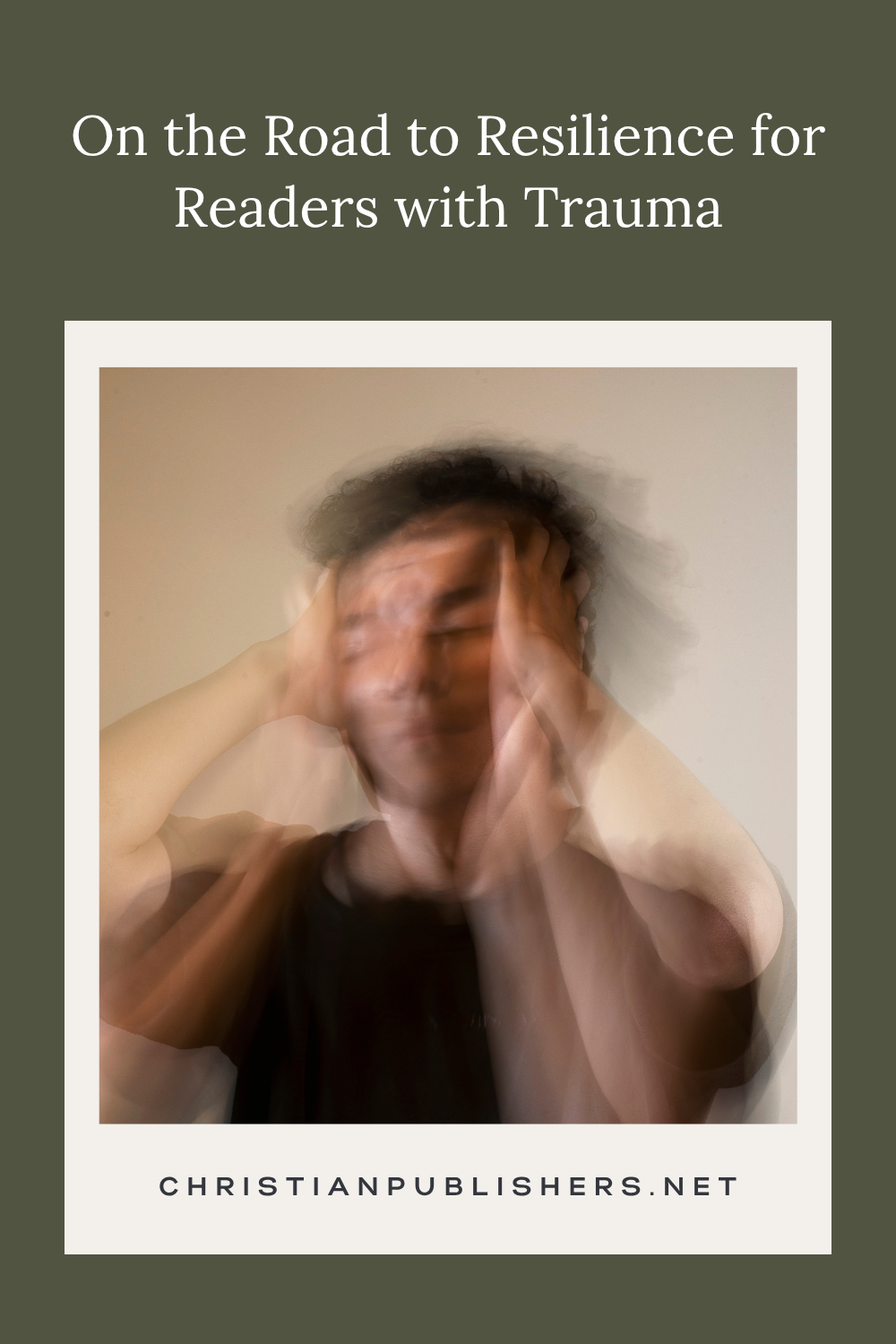
For many, after trauma comes post-traumatic stress disorder, PTSD. Words, aromas, and other stimuli associated with traumatic events connect to the memory and lodge in the emotion center of the brain. Later, when those stimuli occur again, they can trigger a trauma response. This trauma response propels the person back to physiological distress (rapid heartbeat, shortness of breath, and fight or flight reactions), and emotions (fear, false guilt, shame, anger, and disgust) as if the traumatic event were happening again.
Traumatic events in childhood—especially if without support—can seem to be forgotten, but subconscious unanswered questions and untreated wounds fester. Triggers can blindside and derail a person with childhood trauma in perplexing ways. She may have unexplainable quirks or disproportionate fears. He may disconnect and zone out during certain situations. They may rage against a book or author without really understanding what it is they don’t like or stop reading altogether and avoid the emotional upheaval that can ride on the power of words.
Trigger words are roadblocks on the road to resilience, blocking our readers from the bridge and sending them on a detour that may take hours, days, or years to get around.
How important is it, then, to be more aware of common words we might be using without realizing they may trigger our audience and hinder their journey toward resilience?
Are you ready? Here are some MAJOR TRIGGER WORDS you might never have suspected.
Drum roll, please. . .
SHOULD
OUGHT TO
MUST
HAVE TO
Yep, these simple directives often present a problem for people with a history of trauma.
And these words are everywhere in our pieces! It’s no wonder that we Christian writers are familiar with their use and wield them with barely a second thought, because directives and commands are plentiful in most translations of the Bible. The New Testament alone holds over a thousand commands.
But for many victims of trauma, simple directives can trigger shame—the feeling of not being enough, not being good enough, and the motive to perform a certain way for acceptance. The sense of shame—or avoidance of the same—blocks the bridge between a person’s pain and the truth of God’s love and acceptance. The shame of the shoulds lengthens the journey to resilience, where the truth of the gospel deep at heart and mind gives us superpower.
How do we eliminate roadblocks and rebuild that bridge?
We start with ourselves.
Consider times in your life when you may ‘should’ on yourself.
“I really should get the laundry done today.”
“I ought not eat this candy bar.”
“I have to read my Bible and have quiet time every morning.”
“You must pay the rent.” (If you smile at this one, you’re probably at least my age—it’s from an old movie. Free high five if you can name it in the comments)
While it is true that there are many things we should and should not do (if we want things to go well), we thrive in response to empathy, freedom, and love. What Jesus did on the cross sets us free from the letter of the law—so free that we can admit we never could live up to it in the first place. His atonement and the power of the Holy Spirit let us choose to respond to His love rather than ‘should-ing’ on ourselves.
We take the bridge to resilience. Trauma-informed language lets our readers do the same.
If we practice catching when we “should” on ourselves or our families, where we’re most likely to do it, then we can go deeper, noticing ways we’re living out of fear, law, and sacrifice instead of mercy. Perhaps we’ll even realize we’ve deeply buried harsh self-talk and receive some long-needed grace and healing. We might begin to apply His radical love more fully to ourselves, our families, and our readers.
Then we can begin to edit for these trigger words in our writing. Implied triggers (by how and what we share) are on the chopping block, too. If our message feels rigid, we season it with the salt of grace as the Apostle Paul instructed.
“Let your conversation be always full of grace, seasoned with salt, so that you may know how to answer everyone.” -Col 4:6, NIV
As we gain experience with these edits, trauma-informed language comes more readily. With an emphasis on choice, empathy, and mercy, we can spare our readers unnecessary detours around the river of shame and facilitate the trip to resilience.
Here’s an example of how one simple, seemingly innocuous sentence can be perceived as legalistic or shame-producing, followed by a trauma-sensitive edit. I’ve borrowed it from what I may (or may not) have written in my first draft of this post.
“To avoid harming your trauma victims, you should be on the lookout for these trigger words in your writing.”
To which a mild trauma response might be:


“Oh, I’d better make sure I never let these words slip into any of my writing.”
A stronger trauma response might be:
“Another thing I’ve done wrong? I don’t know why I thought I could write. I should just give up.”
Here’s one possible trauma-informed edit to the above “should-y” line:
We do well to scrutinize the use of these common trigger words, considering how they might be perceived by people who have survived trauma, and to emphasize respect, choice, mercy, love, and acceptance.
Now you try it. In the comments, share a snippet you’ve written that needs help, and your edited version. We’ll learn from each other.
Hint: words like can and could in place of have to and “should” tend to offer freedom of choice and respect autonomy.
Common trigger words and tips to support trauma-informed care are plentiful online. Below are some professional links and resources to learn more. I invite you to share tips and resources you’ve found and any feedback or related stories in the comments below. Together, we’ll help each other eliminate roadblocks and get on the bridge to resilience.
Reference Links:
- Percentage of people experiencing trauma:
https://www.thenationalcouncil.org/wp-content/uploads/2022/08/Trauma-infographic.pdf
- Gutsy website called Not in Our Church (dedicated to exposing and dealing with the high prevalence of abuse in churches):
https://www.notinourchurch.com/statistics.html
Other Links and Resources:
Shame-sensitive practices:
https://doi.org/10.1057/s41599-022-01227-z
Trauma-Sensitive Language for Children Free PDF:
ACF615-Words-Matter-Resource-Portrait-v6.pdf
Free eBook:
Creating a Trauma-Informed System of Care [E-book]
Educational links:
https://www.mirecc.va.gov/visn6/Docs/0987_RICVA_REBT_FacilitatorsGd_F2_508_compliant.pdf
The Antidote for Shame | GROW Counseling
Author Bio
Author Joan T. Warren brings her life work in addictions ministry and occupational therapy to her writing, promoting heartfelt healing and healthy relationships. You can find and connect with her at www.joantwarren.com and on Amazon, Facebook, Instagram, and Pinterest.